Personality Prompting
Curatorial Voice
AI Guide

This is post #2 in our AI Guide series, see our previous post here
For decades, artificial intelligence was little more than a glorified flowchart, a rigid logic of “if-then” rules that could classify data at inhuman speed. It did, however, notoriously lack anything resembling human warmth, nuance, or charm, and for a long while it kept to its course.
Modern transformer and vector models changed everything over the last ten years. AI no longer just matches keywords; it maps complex constellations around even the most embodied and inexpressible of our human concepts, including "idiosyncrasy," “connection,” or "warmth.” Shaping a museum AI guide’s personality is now as simple as tweaking a backend prompt.
But effective prompting is equal parts technical precision and creative discipline. The challenge isn't just giving an AI guide for museums a voice, but knowing when simplicity is essential vs. when deep institutional expertise is required.
The Institutional Challenge for Museum AI Guides
Before typing a single line of a prompt, museum staff must confront three core anxieties:
The Trust Deficit: Cultural institutions are public stewards. They deal with the duty of care. The anxiety isn't just about factual accuracy (we’ll cover AI hallucinations in our next post). The question becomes, can a digital tool handle visitors with the empathy and respect they deserve and is required for a rich visit?
Diluted Authority: Fear that an off-the-shelf product will reduce centuries of nuanced scholarship into generic, enthusiastic chatbot trivia.
Replacement Anxiety: Staff and docents worry AI is designed to stand in for human connection and replace human labor, rather than amplify and elevate it.
Personality prompting is one place where these fears are either confirmed or resolved. A lazy prompt yields a generic, transactional chatbot or a chatbot that tries to ape the role of a human docent. But when prompting is treated as an exercise in voice and values, AI guides can act as a thoughtful extension of, and complement to, the institution's value of care.
The Technical How-To for a Museum AI Guide
Here is a breakdown of where prompting works best in the simplest of terms, and the places where your prompting should be served by the expertise of your accomplished staff. It's not that one is less or more important to the visitor experience. Rather, achieving the right results requires a complementary understanding of how you honor both the visitor and your institutional legacy.
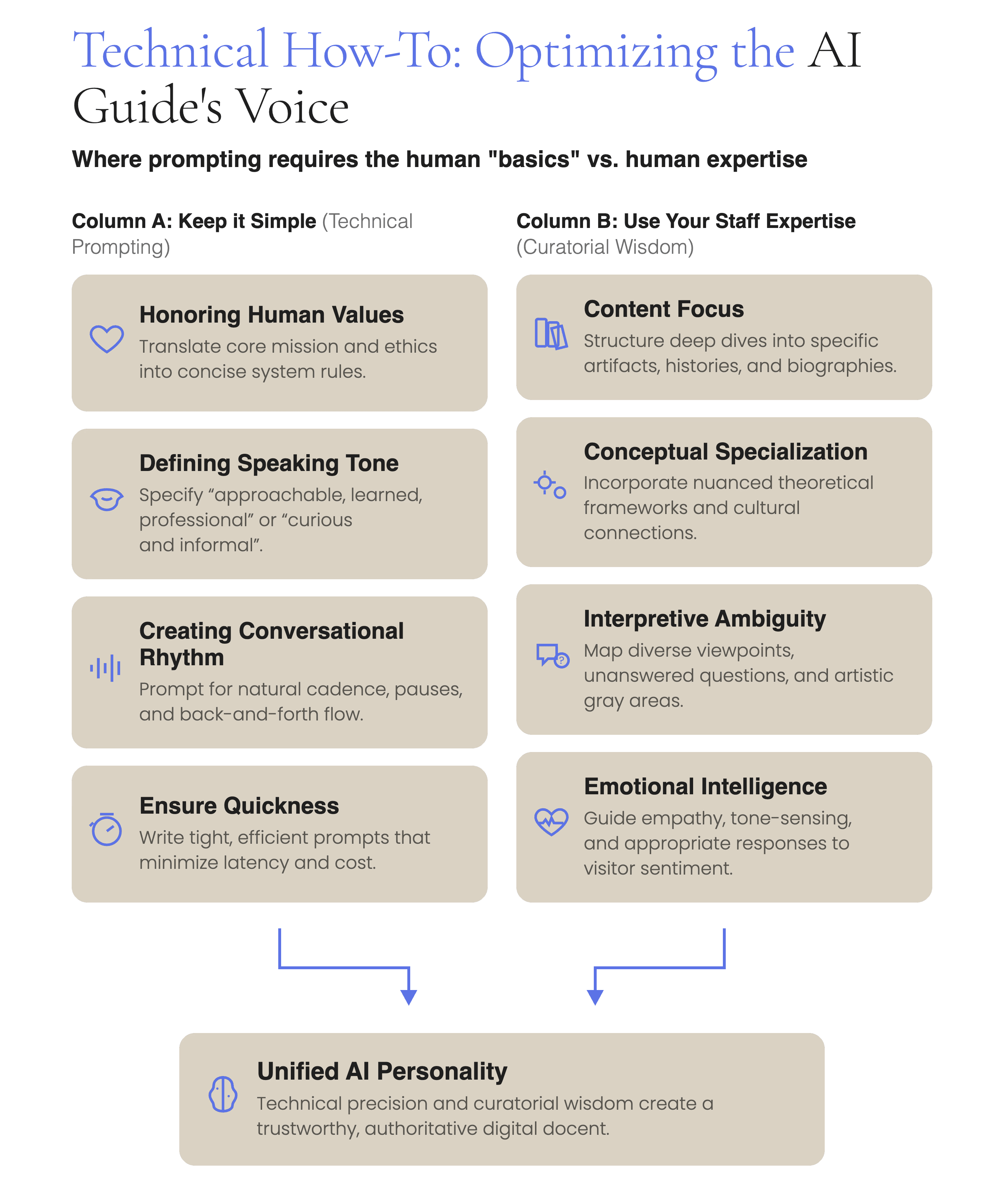
What takes refining, and where Tema Creative puts its focus, is helping museums and cultural institutions translate their specializations, from the remits of relevant content to nuanced interpretive methods, into clear instructions.
All this depends on your AI guide behaving as a charming robotic assistant. The guide doesn’t hold your institutional expertise, but it can powerfully amplify your insights. The guide can’t make your original claims, but it can deftly translate them for different visitors. The guide’s personality shines when it fulfills its role as a tool for learning and enjoyment, bringing visitors closer to the very humans (your staff and fellow community members) who make the cultural institution invaluable in the first place.
The Human Impact: Tema’s Biography Guide for Museum AI
Biography is notoriously tricky terrain for museum educators. A poorly prompted AI guide defaults to flat reductionism, equating an artist’s personal history directly with their creative production.
To prevent this, Tema has built a biography guide for AI guides grounded in contemporary curatorial theory.
We prompt systems to recognize that creators use objects in multifaceted ways: as tools to process emotions, as lenses to navigate modern life, as surrogates for the self, or as bridges to connect across sameness and difference.
We ask visitors to reflect on how these same biographical themes manifest in their own lives.
We use institutional sources that include references to the creator’s own quotes and statements, helping the artist’s voice remain front and center
Crucially, biographical context is always treated as a complement to creative expression, never as an explanation that overpowers the artwork, object, or artifact itself.
At its core, personality prompting isn't about teaching an AI how to speak. It’s about capturing your institution’s own biography and distilling those histories and values as best as we can. Together, we build an AI guide that honors your collection, elevates your staff’s expertise, and deepens the human connection at the heart of every visit.


