AI Guide
Conversational Memory
The Human Impact

Introduction
The legendary Pixar storyteller Andrew Stanton once observed that audiences actually want to work for their meal; they just don’t want to know that they’re doing it.
An exceptional museum guide operates on this very premise. Engaging the visitor’s curiosity is where the true craft of guiding takes place. Delivering accurate information is a non-negotiable prerequisite, a baseline obligation. But a transformative experience rests on the subtler, invisible mechanics that allow engagement to flourish: deliberate consideration, the ability to hold space for complexity, the confidence to grant breathing room, and the discipline to facilitate personal meaning rather than prescribe it.
All of these qualities hinge on a single foundation: continuity.
Without intentional setups, respect for the visitor’s pacing, a memory of what has already been explored, and an active presence to the conversation unfolding in real time, a guided experience quickly collapses into something, well, robotic.
Conversely, when a guide recalls a question asked three galleries back, weaves quiet callbacks into new observations, and tracks the recurring themes a visitor gravitates toward, the experience changes entirely. The visitor’s journey stops feeling like a catalog search and becomes cohesive, sustaining, and vibrant.
The Institutional Opportunity: The Three Layers of Memory
Building this continuity requires expanding how we conceive an AI’s memory. We’ve already explored how personality prompting sets the boundary for respectful human interactions, and how fenced RAG anchors factual truth. But true narrative flow demands three deeper, concurrent layers of memory:
Conversational Memory: Tracking what the visitor has asked, noticed, and gravitates toward.
Spatial & Institutional Memory: Mapping not just the isolated artifact, but the exhibition’s spatial logic, neighboring works, and broader collection relationships.
Existential Memory: Holding a working understanding of why the visitor is here: not to absorb information, but to bring themselves into dialogue with culture.
Our guides are built with all three layers working in tandem.
Let’s dig in.
Our Technical Approach: The Architecture of Continuity
Translating these three layers of memory from a conceptual framework into a working digital infrastructure requires a deliberately engineered architecture. Rather than treating an AI interaction as a series of isolated, stateless prompt-and-response transactions, our platform builds and sustains context across time, gallery spaces, and visitor intent.
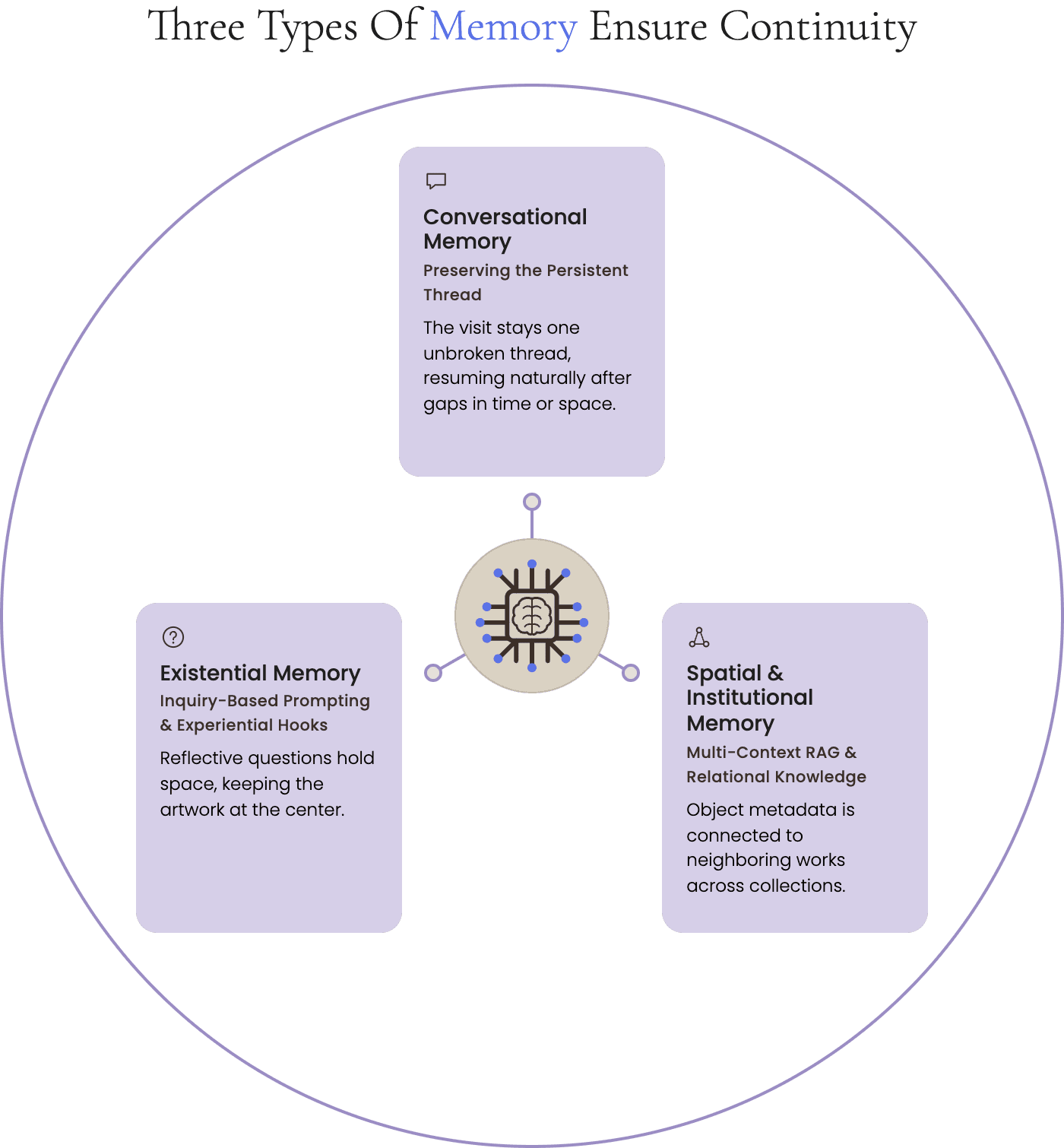
Conversational Memory: Preserving the Persistent Thread
A museum visit rarely unfolds in a straight line. A visitor might spend twenty minutes analyzing a print series, wander into a contemporary installation, and pause for a half-hour coffee break before stepping into the next wing. In standard conversational interfaces, these temporal and spatial gaps cause session degradation or context resets. On our backend, the visit remains one unbroken thread. When the visitor re-engages, the system picks up the dialogue naturally, preserving the cognitive and emotional investment they have already made in the art.
Spatial & Institutional Memory: Multi-Context RAG & Relational Knowledge
To anchor the experience in the museum's specific physical and intellectual framework, we deploy a multi-context Retrieval-Augmented Generation (RAG) architecture. Rather than querying isolated object descriptions, our pipeline connects distinct storehouses of context simultaneously. When a visitor encounters a specific object, the system retrieves both its immediate metadata and its relationship to neighboring works. By connecting objects across distinct data sources, we enable the cross-collection narrative weaving that turns isolated items into a unified story.
Existential Memory: Inquiry-Based Prompting & Experiential Hooks
Sustaining existential memory (why is engaging with this work meaningful to me, or at all?) is fundamentally a pedagogical challenge. We design our conversational models around observation questions, personal reflections. The AI guide is calibrated to hold space and grant breathing room, stepping back to let the artwork take center stage. At its absolute best, the technology becomes a responsive catalyst for deep curiosity and personal discovery.
The Human Impact: Continuity Enables Discovery
In a museum dedicated to Western European art from 1820 to 1920—a century marked by radical stylistic shifts—a visitor felt overwhelmed and alienated by the gallery of modernist abstraction. Disheartened, she retreated into an earlier, traditional gallery and paused before an 1875 pastoral canvas. The painting depicted a farmer and his draft animals bathed in early morning light. What captivated her was a subtle, striking detail: a crisp, luminous halo outlining the farmer’s silhouette, transforming an everyday figure into something mysterious and imposing.
She posed a simple question: "Where else can I find light like this?"
Instead of pointing her toward another 19th-century landscape, the guide offered an unexpected connection: "Try stepping back into the gallery of modernist abstraction. There is a painter working decades later who uses a remarkably similar halo effect to give abstract figures that same sense of presence and enigma."
She decided to revisit the gallery she had previously given up on. She wrote in her post-visit feedback that comparing the glowing outlines across two radically different movements became the highlight of her visit. More importantly, she ended up spending meaningful time exploring an entire collection she would have otherwise walked right past.
This breakthrough wasn't an accident; it was narrative continuity in action. Delivering a moment like this requires all three memory layers working seamlessly together.When technology operates with this level of context, an AI guide becomes a crucial partner in creating personal meaning and unforgettable experiences.


