Museum Knowledge Base
AI Guardrails
AI Guide

The Institutional Opportunity
How do you know you're talking to a great AI guide for museums, one grounded in an institution's own collections, shaped by its voice, and built to use its non-human strengths to deepen your understanding? Simple: it feels extraordinary. Let's look at why.
This only happens when cultural institutions make deliberate technical decisions in service of their visitors. The payoff is inspiring, from accessible expertise to personalized experiences to community-driven dialogues.
This process starts with the right infrastructure.
At Tema Creative, we believe that infrastructural transparency matters, a lot.
When cultural institutions understand the mechanics behind a museum AI guide, they are better equipped to shape it, to ensure that every response reflects their intent. A meaningful AI guide for museums isn't a single piece of software, it's a chain of technologies working together, each performing a distinct role before a single piece of content reaches the visitor.
The Technical Journey of a Museum AI Guide
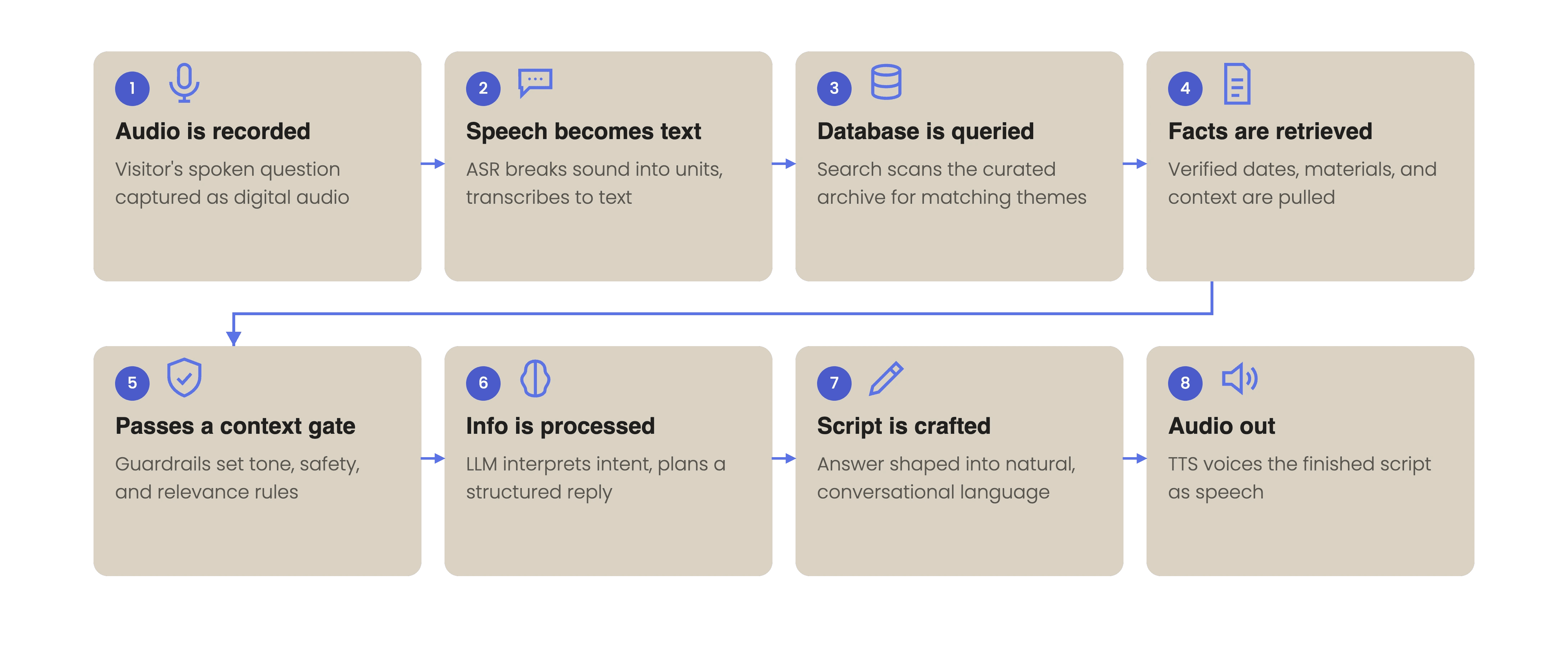
What appears to visitors as a seamless conversation is, in reality, a carefully orchestrated collaboration between multiple specialized technologies. An Automatic Speech Recognition (ASR) engine first converts the visitor's spoken audio into written text, which the system uses to query a curated database for rich historical context, dates, and creator details. Passing these verified facts through institutional guardrails, a Large Language Model then synthesizes an engaging, tailored script. Finally, a Text-to-Speech (TTS) engine converts that script back into natural-sounding audio, delivering a seamless verbal answer to the visitor.
The Human Impact
The most important thing about this AI guide pipeline is that cultural institutions have influence over every stage of it. The conversation should always have the vision and needs of its user at its heart (whether it's the visitor or the curator). The quality of the knowledge base provided to the guide determines the quality of the knowledge being retrieved. The rules you establish should determine how facts are selected, interpreted, and expressed. The choices you make about tone, context, and institutional values should shape the texture of the conversations your visitors have inside your space.
At Tema Creative, we don't just train museums to use this process. From building a robust knowledge base that serves as the institution's source of truth, to designing the systems that decide how information is filtered, compared, connected, and communicated, we make sure a museum's knowledge, ethics, and purpose are reflected in every step.
In the articles that follow, we'll look more closely at the parts of this process that matter most: how to create guide personalities through careful prompting, how to prevent hallucinations with strong retrieval and guardrails, how to connect stories across digital collections instead of individual objects, and how thoughtful design can make these experiences genuinely accessible to every museum visitor.


